


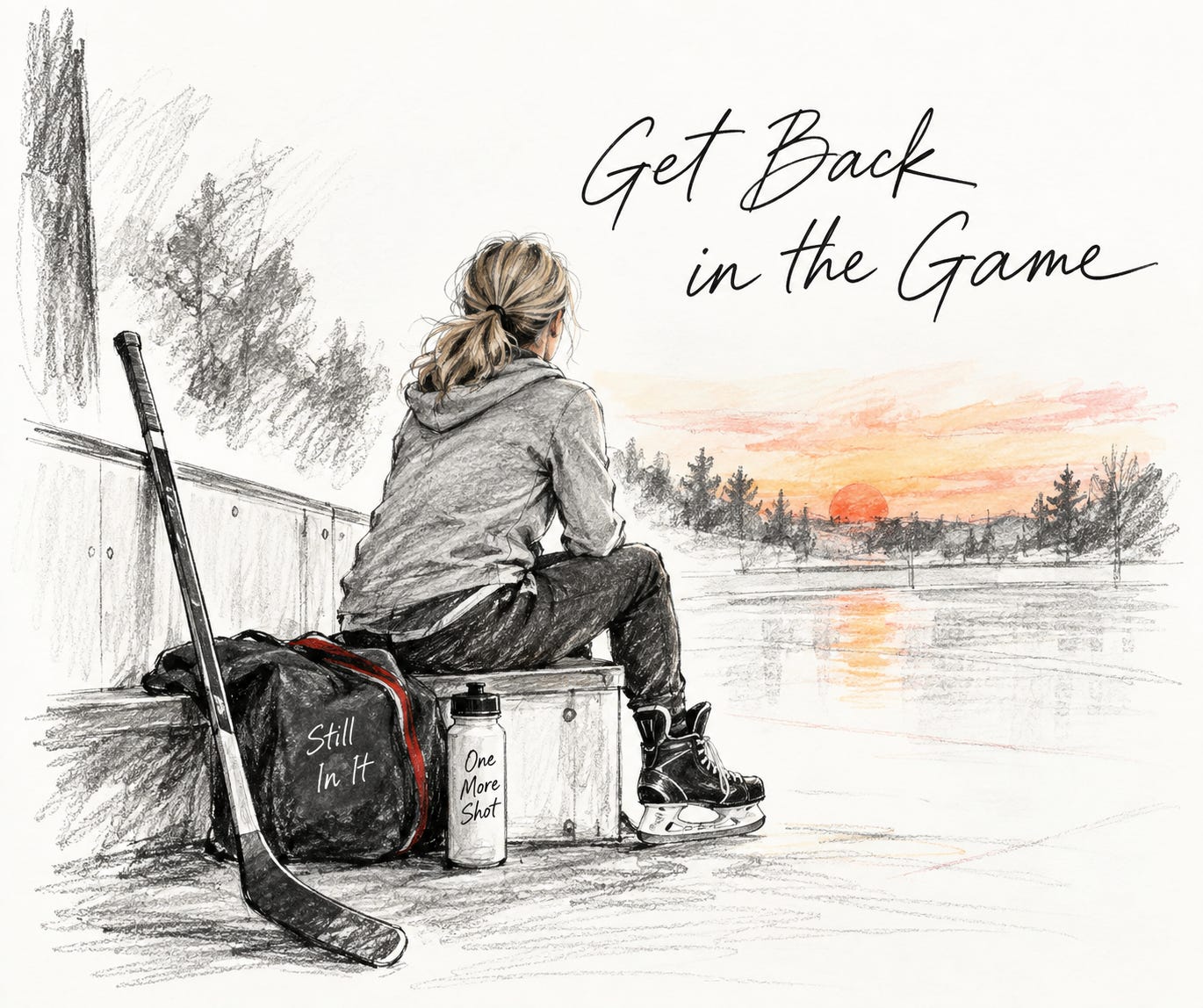
There are plenty of ways to get knocked out of the game, and most of them don’t come with a scoreboard.
Sometimes it’s a career that goes sideways. Sometimes it’s money. Sometimes it’s a marriage, a diagnosis, a rejection, or the slow accumulation of years when you were busy taking care of everybody else and suddenly look up wondering where your own plans went.
That is what I kept thinking about when I wrote Get Back in the Game.
The song is upbeat, fast and full of swagger, but the reason I wanted that sound was because I didn’t want to write another sad song about getting knocked down. I wanted to write about what comes after that. The moment when you stop staring at what happened and start deciding what you’re going to do with what’s left.
And what’s left can be a lot more than we think.
Nobody Gets Through Life Undefeated
One of the first lines in the song says:
Life’s got a funny way of keeping score
You win a few, then you’re flat on the floor.
That sounds almost playful when it’s sung over a driving beat, but there is some truth underneath it. Life can change very quickly. You can be doing fine and then suddenly find yourself trying to understand how everything got rearranged.
Maybe you lose money. Maybe you lose friends. Maybe the thing you thought was permanent turns out not to be permanent at all.
The song gets more specific from there:
Maybe love left with half your stuff.
There are people who will hear that line and laugh because they know exactly what it means. There are others who will feel it land somewhere deeper.
A relationship ends and suddenly you are not only dealing with heartbreak. You are dealing with the house, the bills, the furniture, the routines, the future you thought you had, and the strange task of figuring out who you are now that the life you built has been split in two.
Then there is another line:
Maybe the doctor said words you feared.
That one doesn’t need much explanation.
There are sentences you hear in a doctor’s office that divide your life into before and after. You walk into the room as one person and walk out as somebody who has suddenly been handed a new reality.
The game changes.
That doesn’t necessarily mean the game is over.
Sometimes the Clock Is the Thing You’re Fighting
Another line in the song says:
Maybe you blinked and you lost ten years.
I think that may be one of the quieter truths in the song.
Most people don’t deliberately lose ten years. They spend them.
They raise children. They care for parents. They work jobs they don’t particularly love because somebody has to pay the mortgage. They get sick. They recover. They help somebody else recover. They survive a divorce. They build a business. They lose one. They put dreams on shelves because there are groceries to buy and people who need them.
Then one day they look around and think, Wait. Wasn’t I going to do something else too?
That is where age starts playing tricks on us.
We begin telling ourselves that we missed the window. Somebody younger got the opportunity. Somebody with a straighter career path got the job. Somebody who didn’t have to stop and start five times got farther down the road.
The song puts it this way:
Somebody younger stepped into your place.
That happens in sports, certainly, but it happens everywhere else too.
There is always somebody younger. Somebody faster. Somebody with a newer degree, a cleaner résumé, a bigger following, fewer wrinkles, fewer complications, or fewer years between where they started and where they are trying to go.
That doesn’t mean they get to decide whether you are finished.
The Coach Doesn’t Ask You to Relive the Mistake
Coaching taught me something important about mistakes.
When a player made a bad play, I didn’t want them spending the next five minutes replaying it in their head. The game was still moving. There was another shift coming.
You learn from the mistake, certainly. But eventually you have to get back into the play.
That’s why this line matters to me:
One more shot.
One more swing.
You don’t need permission
To change everything.
Permission is an interesting word.
We wait for it more than we realize.
We wait for somebody to tell us we’re qualified enough, young enough, talented enough, healed enough, financially secure enough, or somehow sufficiently entitled to try.
Sometimes nobody is coming to give that permission.
You may have to give it to yourself.
That doesn’t mean you get everything you want. It doesn’t mean the comeback is easy. It doesn’t mean there won’t be another rejection tomorrow.
It means you get to take the shot.
Getting Back in the Game Does Not Mean Going Backward
I also don’t think getting back in the game means returning to exactly who you used to be.
That person may not exist anymore.
If you’ve been through enough life, you aren’t supposed to be unchanged by it.
The better question may be: Who are you now, and what can this version of you do?
That’s why another idea in the song matters:
You don’t have to be twenty-five
To still have something left to say.
There are industries, workplaces and even social circles that can make people feel invisible as they get older. There is an assumption that ambition belongs to the young, that reinvention is something you do at thirty, and that eventually you are supposed to quietly become grateful for whatever role you already have.
I don’t believe that.
There is no expiration date on having an idea.
There is no age at which curiosity becomes inappropriate.
There is no official deadline for changing direction.
And there is certainly no age at which you have to stop wanting more from your own life.
The Song
That is what Get Back in the Game is about.
It is not really about winning.
It is about participation.
It is about getting back on the ice, back into the room, back into the job search, back to the keyboard, back to the drawing board, back to whatever part of yourself you stopped believing still had a place.
It is about refusing to let the worst thing that happened become the final thing that happened.
Click the play button to listen to Get Back in the Game.
Maybe your game right now is finding another job after being laid off. Maybe it is starting over after a relationship ended. Maybe it is rebuilding after financial trouble. Maybe it is learning how to live in a body that has changed. Maybe it is finally trying something you talked yourself out of years ago.
Whatever it is, you don’t have to know exactly how it ends before you begin.
You just have to decide you are still willing to play.
If you’re still here, you’re still in it.
Get back in the game.
Read the original song release and follow my music and songwriting on Joyce Strong

Join My Team
I’m building Strong Dynamics as a community for people who are still learning, still leading, still rebuilding and still willing to try again after life has changed the plan.
That includes athletes and coaches, but it also includes people changing careers, recovering from setbacks, starting businesses, rebuilding confidence, learning new skills, or simply trying to figure out what comes next.
If that sounds like you, I hope you’ll join me here.
Free subscribers help grow this community and bring more people into the conversation. Paid subscribers make it possible for me to keep writing, creating and building Strong Dynamics into something substantial — a place for honest conversations about resilience, leadership, reinvention, performance and the complicated business of staying in the game.
Join my team, free or paid, and help me build it.