


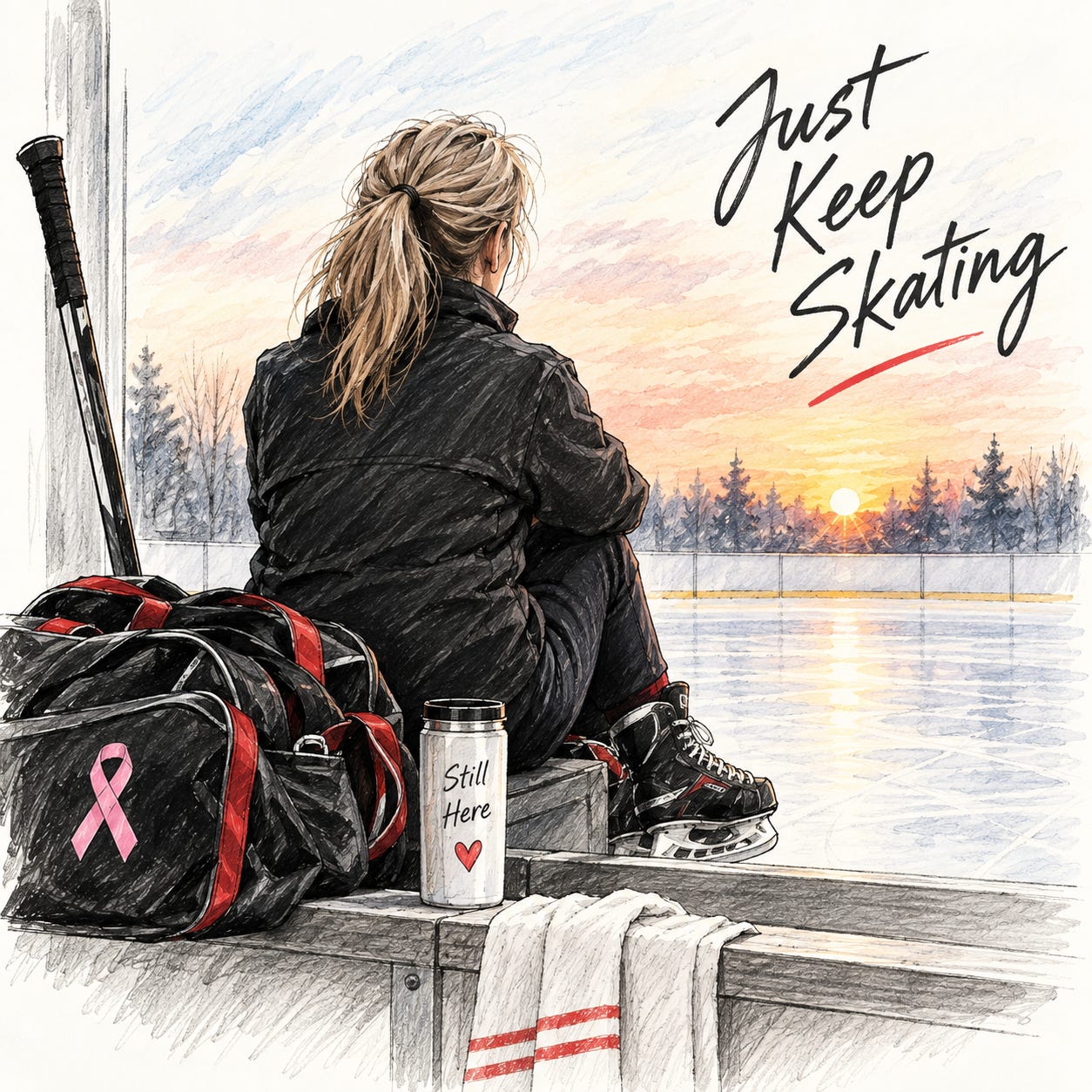
I didn’t become a hockey coach because I was looking for a second career or had some carefully considered plan for reinventing myself. I started coaching when my life was about as unsettled as it could get. I had five kids, my marriage was ending, money was tight, and then I was diagnosed with breast cancer.
It was the perfect storm: cancer, divorce, financial distress, five children depending on me, and not much left that felt secure. Cancer doesn’t arrive after you’ve cleared your calendar and solved the other problems. The bills still come. The kids still need rides and food and somebody paying attention to what is happening in their lives. You still wake up in the morning and have to figure out how you’re going to get through the day.
And somewhere in the middle of all of that, I started coaching hockey.
Looking back, the timing sounds ridiculous. What I needed was less responsibility, not more of it. But the rink gave me somewhere to go where there was a job to do. Practice needed to be planned. Players needed to be taught. Somebody needed help with an edge, somebody wasn’t paying attention, and somebody who couldn’t do something two weeks earlier was suddenly doing it without thinking.
The puck was going to drop whether the rest of my life was cooperating or not.
Learning to Play What Is in Front of You
Hockey doesn’t give you much time to mourn the play you intended to make. You can draw something beautifully on a board and watch the whole plan disappear three seconds after the faceoff. Somebody falls. The puck takes a crazy bounce. A defenseman pinches. A player reads the situation differently than you expected, and now everyone has to respond to the game that is actually happening instead of the one you planned.
My life had become a lot like that.
The future I thought I was headed toward wasn’t available anymore. I couldn’t fix all of it, and some of it wasn’t mine to control in the first place. What I could do was deal with what was directly in front of me and then deal with whatever came after that.
We have a tendency to make resilience sound prettier once we know how the story turns out. We look backward and turn difficult years into a clean narrative about strength, as though the person living through them knew all along that everything would work out. That’s not how I remember it.
Sometimes resilience is very ordinary. You get up. You go to the appointment. You figure out which bill you can pay. You make dinner. You show up for your kids. You go to the rink because there are players waiting for you, and for an hour or two the problems in your own life aren’t the only things demanding your attention.
Then you do it again.
Coaching Made Me Pay Attention
One of the unexpected gifts of coaching during that period was that I couldn’t spend all my time looking inward. Coaching requires you to notice people. Really notice them.
One player responds when you challenge her. Another gets quieter and plays worse. One needs more explanation; another understands perfectly well and needs you to stop talking. A player who looks lazy may be confused. A player who looks confident may be terrified of making the mistake that gets him benched. Sometimes a correction needs to be immediate. Sometimes a kid already knows exactly what went wrong and doesn’t need a coach piling on.
Those aren’t lessons you learn by standing at center ice giving speeches.
You learn them by watching.
Over time I became increasingly serious about the craft of coaching. I continued through USA Hockey’s coaching education until I became a Level 5 coach, and I also went through formal coach training with Wellcoaches. They approached coaching from different directions, but together they gave language and structure to things experience had already begun teaching me.
Good coaching isn’t demonstrating how much the coach knows. It requires listening closely enough to understand what another person actually needs, asking questions that make someone think instead of merely handing over your answer, recognizing patterns, and knowing when to challenge and when to leave enough space for the other person to find their own footing.
That matters on a hockey rink. It matters just as much away from one.
When You Have Nothing to Lose
There is also something that can happen when life has already taken a wrecking ball to your sense of security. Some of the things that frightened you before don’t have quite the same leverage.
I don’t mean that I became fearless. I certainly didn’t. Cancer, divorce and financial uncertainty weren’t some wonderful liberation exercise, and I have no interest in polishing them into one. But once so many assumptions about my life had already been stripped away, I became more willing to move without guarantees.
That turned out to matter.
Athletes do it all the time. They make decisions without knowing exactly how the play will unfold. They read what they can see, commit to something, adjust when the situation changes, and keep participating in the play. Waiting until you are completely certain is not an option because by then the puck is somewhere else.
Life doesn’t always give you much more certainty than that.
Just Keep Skating
Years later, when I started writing songs, I found myself returning to those years and to one of the simplest instructions hockey had given me.
Just keep skating. 🎶 Click the link to read the lyrics and listen to the song here.
I know how that phrase can sound outside hockey: push harder, never stop, grind your way through anything. That isn’t what I mean by it.
Anyone who has played the game knows that skating isn’t a straight line toward the net. You stop. You turn. You cross over. You circle back. You lose the puck and have to recover. You get knocked down. A lane closes and you have to find another one. Sometimes you come off the ice because your shift is over and somebody else needs to take it.
Keeping skating means staying in the play.
There were years when I couldn’t see very far ahead. I couldn’t tell you how everything was going to turn out or what my life would look like on the other side of what was happening. But I could usually see the next few feet of ice, and sometimes that was enough.
What the Rink Taught Me About People
I kept coaching, and eventually I realized that hockey had become one of the places where I had learned the most about people. Not just athletes. People.
I saw what fear does to judgment. I watched talented players become tentative when they were more worried about the coach’s reaction than the play in front of them. I learned that accountability and humiliation are not remotely the same thing, although plenty of coaches confuse them. I saw quiet players hold teams together and gifted players make everyone around them worse. I saw what happened when people trusted each other and what happened when they didn’t.
I also learned that you cannot coach every person in exactly the same way and then blame them when only some of them respond. The standard may be the same. The person standing in front of you is not.
Those lessons followed me into health care, preventive and functional medicine, business, and coaching people outside sports. The setting changes, but much of the human behavior is familiar. Executives lose confidence. Leaders get stuck inside their own thinking. Capable people carry too much because they have become accustomed to being the person everyone depends on. Organizations continue doing something because it used to work, long after anyone has stopped to ask whether it still does.
Sometimes people don’t need another person telling them what to do. They need enough room and the right questions to see what they already know differently.
The Coach Stays Behind the Boards
There is one lesson from hockey that probably explains more about my approach to coaching than anything else.
A coach can prepare a player. From the bench, you may see something the player can’t see from the ice. You can teach, question, challenge, correct, and help someone recognize a pattern they’ve been missing. You can help them become better at reading what is unfolding in front of them.
Then the gate opens.
You stay behind the boards.
They skate the shift.
That has always seemed to me a good test of coaching. The object isn’t to make another person increasingly dependent on your answers. It is to help them become more capable of seeing, deciding, adjusting, and trusting their own judgment when you’re not standing beside them.
Maybe that is part of why coaching found me when it did. At a time when I couldn’t control much of what was happening in my own life, hockey kept reminding me that I didn’t have to know how the entire game was going to end.
I had to look at what was in front of me, decide what I could do next, and keep skating.
Join Strong Dynamics
Strong Dynamics grew out of decades of coaching on and off the ice and my continuing fascination with what happens to people when something matters: how we lead, how we respond to pressure, how confidence is built or destroyed, why some teams work and others don’t, and what helps people change when the old way isn’t working anymore.
I’ll be writing about those questions here, and share books, ideas and resources I’ve found useful along the way. If that sounds like territory you want to explore with me, subscribe and join the Strong Dynamics community.
Joyce Strong
USA Hockey Level 5 Coach