


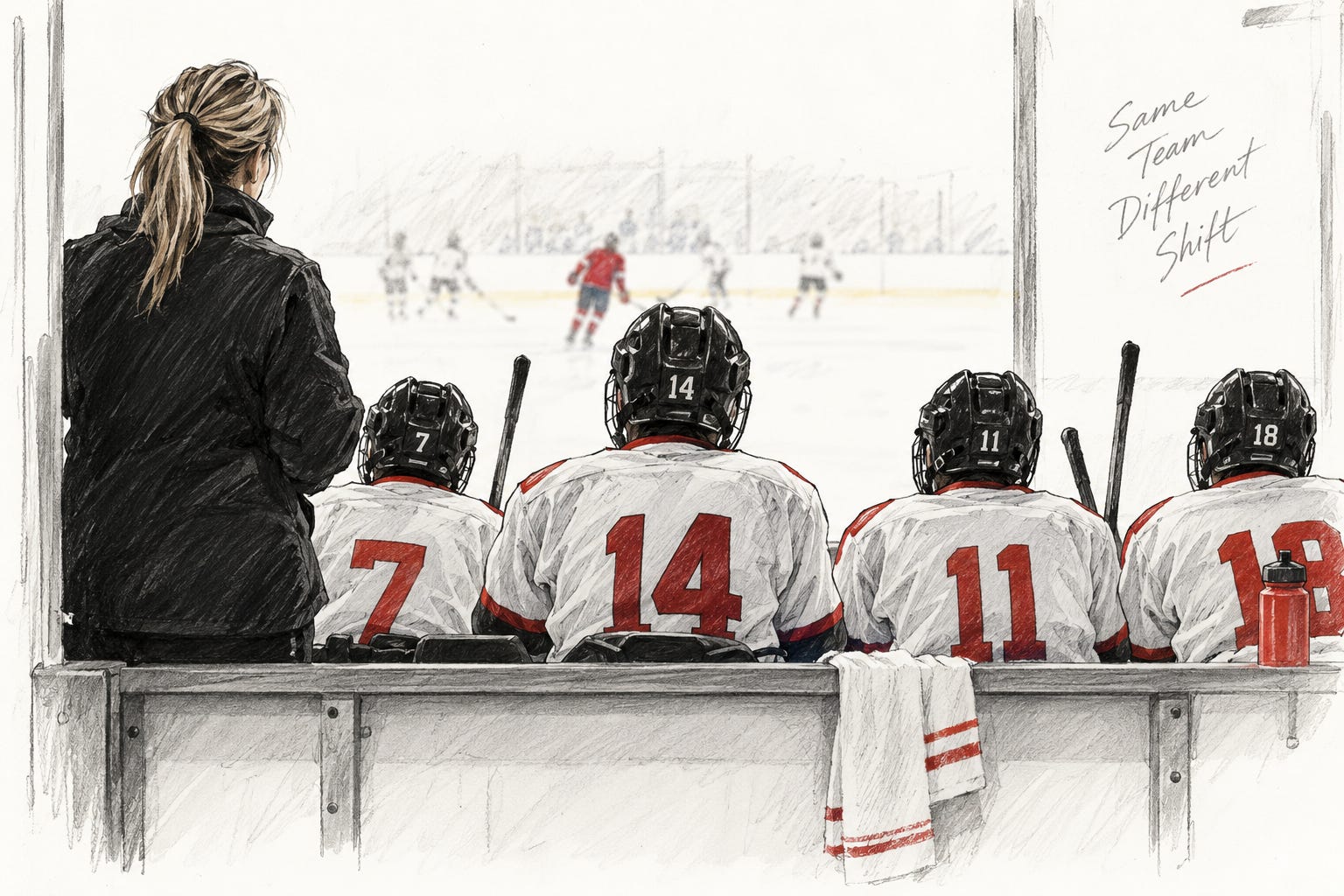
The defenseman turns the puck over at the blue line. Seconds later, it’s in the net.
He comes back through the gate already knowing exactly what happened.
Now watch the bench.
Does somebody move over and make room? Does a teammate say something useful? Does the coach correct the mistake and move on? Or does the whole bench tighten around him as if failure might be contagious?
I spent a lot of years behind hockey benches, and some of the most revealing moments had very little to do with the puck. Watch the player whose ice time has been cut, the kid who expected to be on the power play and isn’t, the star when somebody else scores, or the player who has been sitting through three shifts waiting for a number to be called.
You can learn an extraordinary amount about a team without looking at the scoreboard.
The bench is not where the game stops. It is part of the game.
Everybody Matters When They Don’t Have the Puck
One of the great misunderstandings about team sports is that the action belongs to whoever has the puck, the ball, or the opportunity. In hockey, a player without the puck may be creating the entire play. She may be pulling a defender away from the net. He may be covering for a defenseman who pinched. Someone may be talking from behind the play, identifying pressure a teammate cannot see. Five players can contribute to a goal that gives points to only two or three of them.
The same is true on the bench. Players are watching tendencies and matchups, listening to the coaches, recovering physically, thinking about what just happened, and preparing for the next shift. A player who stays mentally in the game will step back onto the ice differently from one who has spent two minutes stewing over something that happened on the last shift.
That’s one of the things I learned to notice as a coach. A disengaged bench doesn’t magically become an engaged team when the gate opens.
The Shift You Don’t Get
Everybody wants to play. They should. Competitive athletes want the puck, the important shift, the power play, the final minute. They want to be trusted when the game is on the line. I never considered disappointment over lost ice time a character flaw. Sometimes it’s evidence that a player cares very much.
What interested me was what happened next.
A player can disagree with a coach’s decision and still remain part of the team. They can be angry and still pay attention. They can think the coach is completely wrong and still be ready when their number is called. Competitive sports guarantee disappointment. Somebody doesn’t make the team. Somebody loses a starting job. Somebody gets moved off a line. Somebody else gets the assignment you wanted.
This is where we sometimes confuse coachability with obedience. They aren’t the same thing. Good athletes think. They ask questions. They want to understand. Good coaches should be able to explain decisions, and coaches get things wrong just like players do.
Coachability is the ability to receive information, consider it, adapt when necessary, and remain engaged even when your ego has just taken a hit.
That’s a difficult skill in hockey. It’s an even more valuable one in life.
The Bench Reveals the Coach, Too
The players aren’t the only people being revealed.
A defenseman makes a bad turnover and it ends up in the net. Everybody in the building knows what happened, including the player coming back to the bench. What does the coach do with that moment?
There are times when a correction needs to be immediate and direct. There are also times when the player already understands the mistake and piling humiliation on top of it teaches absolutely nothing.
Good coaching requires knowing the difference.
It also requires understanding that a bad result does not necessarily mean a bad decision. Hockey is too fast and unpredictable for that. A player can make the right read and get beaten. Another can make a terrible decision and get lucky. If coaches teach entirely from outcomes, players eventually learn to avoid risk instead of learning how to read the game.
Fear can produce compliance, and sometimes it even produces short-term results. A player terrified of making a mistake may stop making that particular mistake. But they may also stop creating, communicating, trusting their instincts, or attempting something difficult.
Eventually they’re no longer playing the game in front of them. They’re playing the coach behind them, calculating what will keep them from getting yelled at or benched.
That’s not the kind of player most coaches claim they want to develop.
Culture Isn’t the Sign on the Wall
Sports organizations love words like accountability, respect, discipline, hard work, and team first. Put them on a locker-room wall and they look impressive. But those words don’t tell me much about a team’s culture.
Show me how the captain treats the last player on the roster. Show me what happens when the third-line winger misses an open net or when the backup goalie finally gets the start. Show me whether the best player listens while the coach is talking to somebody else.
And don’t only show me adversity. Show me what happens when the team starts winning.
Success reveals people too. Roles change. Attention shifts. Somebody suddenly becomes indispensable, somebody else becomes expendable, and praise starts accumulating around a handful of people. A healthy culture can absorb those changes without convincing everyone else that their contribution no longer matters.
Culture isn’t what a team says it believes. It is what people repeatedly do with one another, especially when nobody is standing over them telling them how to behave.
Every Organization Has a Bench
This is where hockey stops being only about hockey.
Every organization has people holding the puck right now and people whose contribution is harder to see. There are people getting recognition and people doing essential work nobody notices. Someone is waiting for an opportunity. Someone is recovering from a mistake. Someone else is wondering why another person got the assignment they wanted.
I’ve worked in health care, coached athletes, and spent enough time inside organizations to see these dynamics repeat themselves.
When people believe their value disappears whenever they aren’t at the center of the action, you don’t really have a team. You have individuals temporarily occupying the same organization.
Strong teams understand something different: your role can change without eliminating your responsibility to the group, and your role can change without eliminating your value to it.
That distinction matters.
Leadership Doesn’t Always Have the Puck
We tend to look for leadership in obvious places: the captain, the coach, the star, the person giving the speech.
Some of the best leadership I’ve seen in sports was much quieter than that.
It’s the player who says the right thing to a teammate after a mistake without pretending the mistake didn’t happen. It’s the veteran who notices that a younger player is sitting alone. It’s somebody recognizing that a teammate has already been corrected and doesn’t need six more people piling on. It’s the player getting fewer minutes than they want who keeps watching because when the opportunity finally comes, they intend to be ready.
None of those things appear on a scoresheet. They can still change the outcome of a game.
That’s one of the reasons I have always loved sports. Strip away the uniforms and the scoreboard and you’re watching human dynamics unfold in compressed time: confidence, fear, ego, generosity, resentment, trust, courage, selfishness, discipline, and leadership.
Pressure doesn’t necessarily create those qualities.
Very often, it simply reveals them.
Watch the Bench
The next time you watch a hockey game, spend a few minutes looking somewhere other than the puck. Notice what happens after a mistake. Notice who remains engaged when they aren’t playing. Notice how the best player treats the weakest one and what the coach does when the game begins slipping away.
You may discover that some of the people doing the most to hold the team together aren’t the ones showing up in the highlights.
They may be sitting three feet away from the coach, waiting for the gate to open again.
And once you learn to see leadership there, you start seeing it everywhere.
Join Strong Dynamics
Strong Dynamics begins with sports, but it isn’t only about sports. I’m interested in what competition teaches us about leadership, performance, confidence, communication, culture, resilience, and the way people behave when something is at stake.
I’ll be writing about those connections here, drawing on decades of coaching and my experiences in health care, business, and life. Over time I’ll also share books, coaching resources, and other tools I believe are genuinely worth using.
If this is the kind of conversation you want more of, subscribe and join me.
The puck tells you what’s happening in the game.
The bench often tells you what kind of team you’re watching.
Joyce Strong
USA Hockey Level 5 Coach