


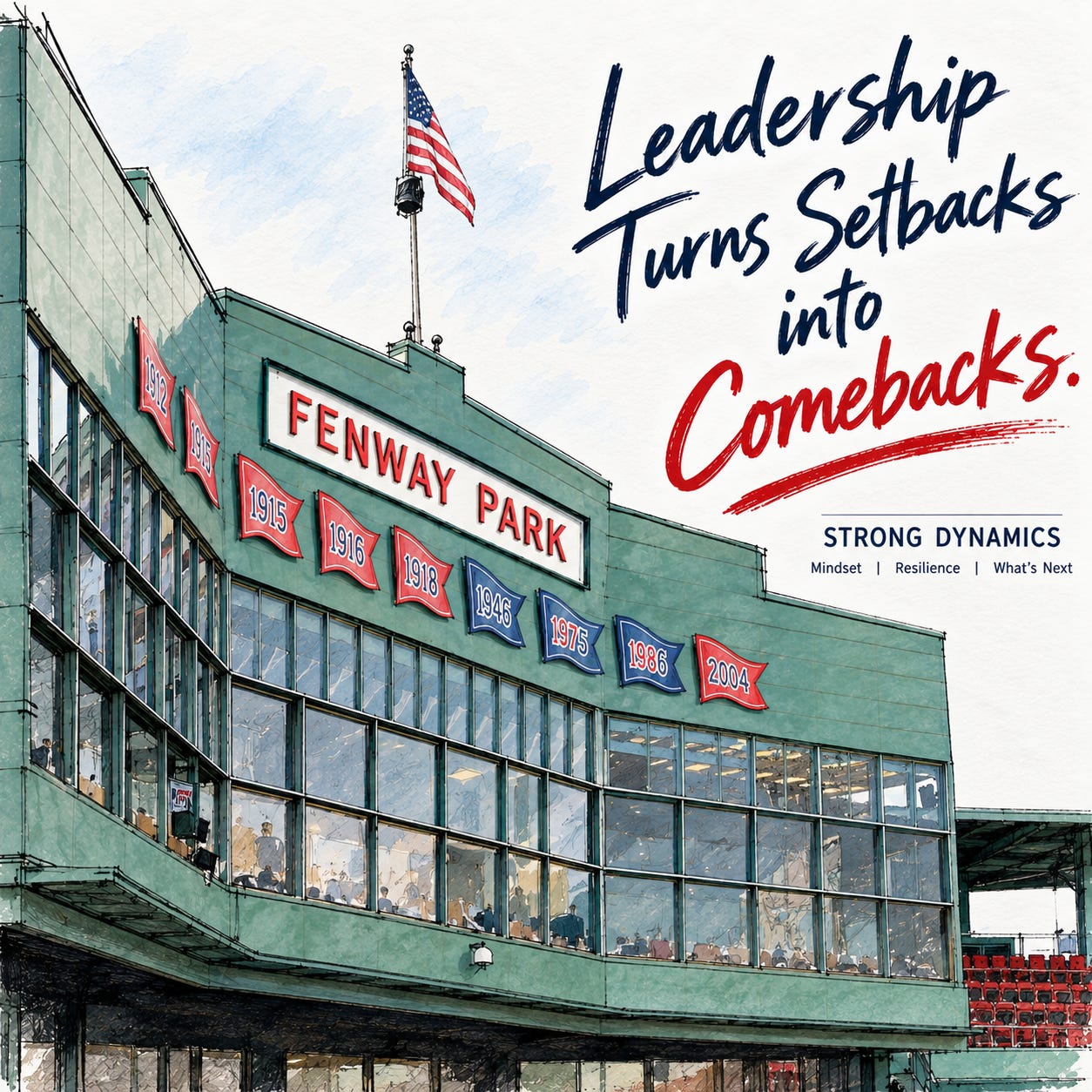
On June 24, the Boston Red Sox were 32–46. They were 15½ games out of first place in the American League East, six games out of a Wild Card spot, and eight teams stood between Boston and postseason position. If you looked at the standings that morning, there was plenty of evidence supporting one very reasonable conclusion: this season wasn’t going anywhere.
Three months later, the Red Sox are going to October.
On September 20, Boston clinched a postseason berth. Along the way, the Red Sox became the first team in Major League Baseball history to lose 46 of its first 78 games and still finish with a winning record.
There is a lesson buried inside those numbers that has very little to do with baseball.
The Score Tells You Where You Are, Not Where You Have to Finish
One of the most dangerous things we do when we’re struggling is turn a current condition into a permanent conclusion. We look at the scoreboard, the bank account, the scale, the business numbers, the relationship, the diagnosis, the race standings or the collection of mistakes behind us, and we decide that what is must also be what will be.
I’m behind, therefore I can’t catch up. I failed, therefore I’m a failure. I’m losing, therefore I’ve lost. This isn’t working, therefore it will never work.
But 32–46 was a score. It wasn’t a prophecy.
That record accurately described what had already happened to the Red Sox. Forty-six losses were real, and none of them could be taken off the board. But the record contained absolutely no information about what Boston was going to do on June 25.
The next game hadn’t been played yet.
You Don’t Have to Fix the Whole Season Today
This is where people often get overwhelmed. We see the size of the hole and think we somehow have to climb out of the entire thing at once. The distance between 32–46 and October looks enormous when you stare at it from the bottom.
The Red Sox couldn’t wake up on June 25 and erase 46 losses. They couldn’t replay April, fix May or go back and make June different. Those games were over. All they could control was what happened next.
So they played the Yankees.
Boston swept all four games at Fenway. Then the Red Sox kept playing. In July, they put together a 15-game winning streak that tied the franchise record. After that streak ended, they kept playing.
Eventually Boston produced the best 30-game stretch in Red Sox history, going 27–3. From June 25 through August 7, a team that had begun the year 32–46 went 32–5.
Same season. Same organization. Many of the same players.
A completely different trajectory.
Momentum Doesn’t Arrive Before You Move
We talk about momentum as though it is some mysterious force that arrives and carries successful people along with it. More often, momentum begins much less dramatically.
You do the next thing.
Then you do it again.
You get one result that is slightly better than the last one. That gives you a little evidence that change might actually be possible. Your confidence increases, your decisions improve, other people begin responding differently to you, and the evidence starts accumulating in a new direction.
The Red Sox couldn’t think their way out of 32–46. They couldn’t talk their way out of it either. They had to play their way out, one game at a time, until the standings finally reflected what they had been building.
That’s one of the most important principles in performance psychology: confidence doesn’t always have to come first. Sometimes action comes first, evidence follows, and confidence grows because you have finally given yourself a reason to believe again.
A Bad Chapter Is Not the Ending
This applies far beyond sports. There are seasons in life when the numbers really are bad, and resilience does not require pretending otherwise.
Maybe you’re behind financially. Maybe your business isn’t working the way you thought it would. Maybe your body isn’t performing the way it once did. Maybe you’ve lost your confidence after a failure, rejection, injury or long period of struggle. Maybe you’ve invested months or years in something and have very little to show for it.
Looking at the scoreboard isn’t pessimism. It’s information.
The mistake is deciding the scoreboard also knows the future.
There is enormous power in being able to look directly at 32–46 and say, Okay. That’s where I am.
Then ask the only question that can actually change anything:
What do I do next?
Perfection Was Never the Requirement
Last week, Red Sox rookie Payton Tolle gave us an almost absurd example of baseball perfection. He opened a game against Kansas City with an immaculate inning: nine pitches, nine strikes and three strikeouts.
For one inning, everything worked.
But nobody gets an immaculate season.
Sports don’t work that way, businesses don’t work that way, relationships don’t work that way, and lives certainly don’t work that way. Most meaningful accomplishments include mistakes, bad stretches, injuries, wrong turns, losses, failures and moments when absolutely nothing seems to be working.
Mental toughness isn’t pretending those things don’t hurt. It is refusing to turn them into an identity.
You can have a terrible inning without being a terrible pitcher. You can have a losing stretch without being a loser. You can be 32–46 without knowing how the season ends.
Stay in the Game
When the Red Sox finally clinched their postseason berth Sunday, “Stayin’ Alive” was playing in the clubhouse. The joke almost writes itself, but underneath it is the entire lesson of the season.
Sometimes staying alive is the strategy.
You don’t need to know today how you’re going to get all the way from where you are to where you want to be. You need enough discipline, courage and patience to stay in the game long enough to take the next meaningful action.
Then you take another.
There is no guarantee that every comeback ends in October. Sometimes the hole really is too deep, the clock does run out or the goal has to change. Resilience isn’t a promise that persistence always produces the outcome you wanted.
It is the refusal to declare the ending before you have actually reached it.
On June 24, the Boston Red Sox were 32–46.
On September 20, they were spraying champagne.
32–46 was the score. It wasn’t the prophecy.
Whatever your scoreboard says today, look at it. Learn from it. Respect what it tells you.
Then decide what you are going to do next.
Join My Community
Strong Dynamics is about performance, resilience, mindset and what happens when the game — or life — doesn’t go according to plan. It is about developing the mental skills to compete, recover, adapt, lead and Get Back in the Game. 🎶
If those are conversations you want to be part of, subscribe and join the Strong Dynamics community. I’ll be writing about athletes, teams, coaches, leadership, performance psychology and the lessons sports can teach us long after the final whistle.
If this work gives you something useful to carry into your own sport, business, leadership or life, please consider becoming a paid subscriber. Paid subscriptions help support the time and work that go into building Strong Dynamics and allow me to keep more of this writing available to everyone.
Sources
Major League Baseball, “’Stayin’ Alive!’ Red Sox clinch postseason spot that once seemed improbable,” September 20, 2026.
Major League Baseball, “What’s behind the Red Sox’s midseason surge?” July 20, 2026.
Major League Baseball, “He knew! Tolle cracks smile before capping immaculate inning,” September 14, 2026.