


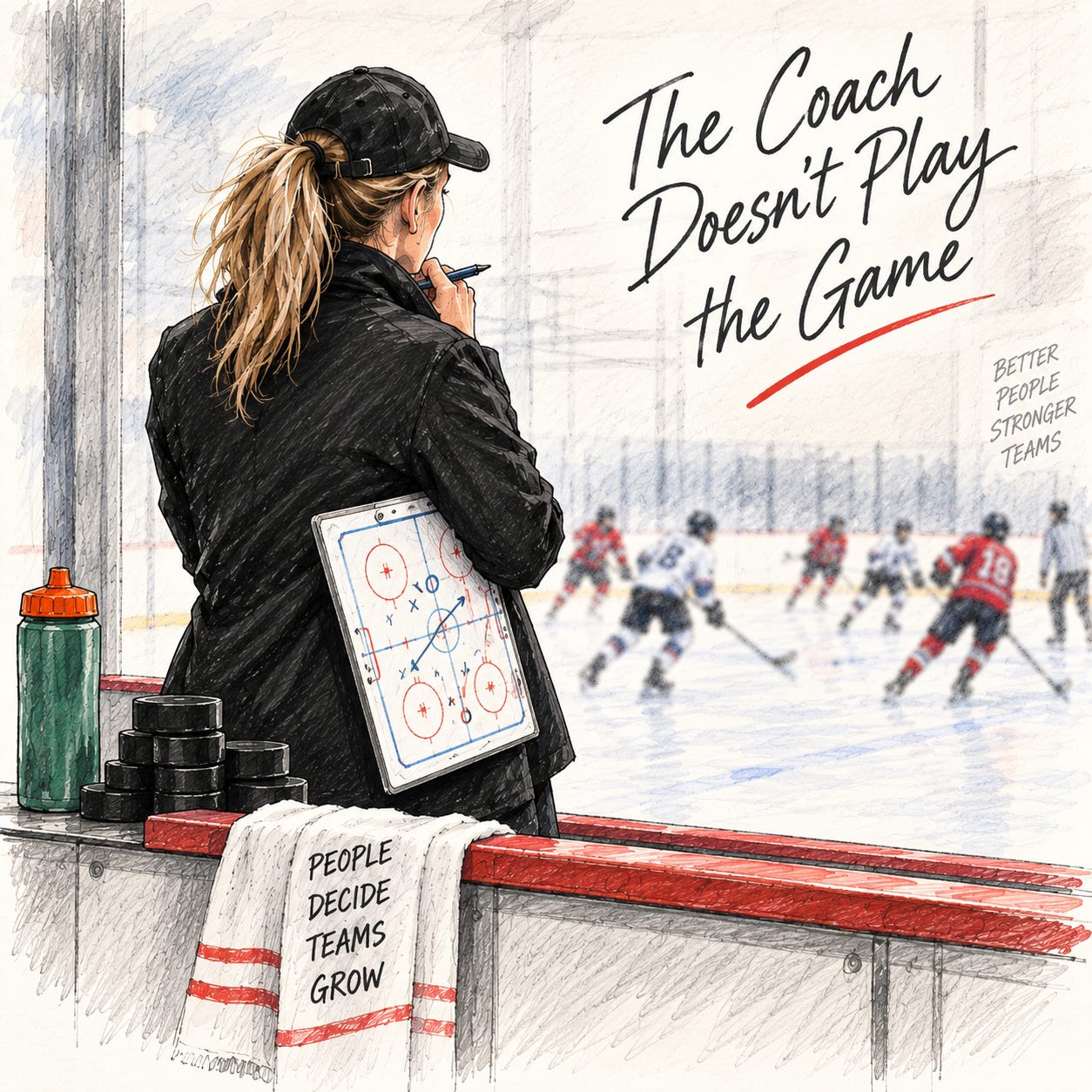
There is a moment behind a hockey bench that every coach knows. You can see the play developing. You know where the pressure is coming from, you can see the open ice, and maybe you’ve practiced this exact situation all week.
You also can’t do a damn thing about it.
You don’t have the puck. The player does.
You can yell from behind the boards, and hockey coaches certainly aren’t known for their silence, but the game moves faster than instructions shouted from the bench. By the time a player hears you, processes what you’ve said and tries to act on it, the play may already have changed. At some point the player has to see what is happening, make a decision and live with it.
That is one of the hardest things about coaching, and leadership isn’t much different.
You can prepare people. You can teach them what to look for, talk through situations, establish expectations and correct mistakes. But if everything still has to come through you before anyone can act, you haven’t built much capacity around you. You’ve built a system that works as long as you’re standing there.
The Trouble With Being the Person Who Can Fix It
This can be especially hard for capable leaders because being useful is often how they got where they are.
You solve problems. You know the business. People come to you when something is difficult because you’ve probably seen some version of it before. When you can make the decision in five minutes and somebody else may need an hour, stepping in feels efficient.
Often it is efficient.
Today.
Keep doing it long enough, though, and people learn something you may not have intended to teach them: the safest decision is to wait for you.
Managers start bringing problems instead of recommendations. Employees become careful about exercising judgment because experience has taught them that the answer will eventually come from above anyway. The executive works longer hours, complains that nobody takes enough initiative, and continues making most of the decisions that would allow people to develop initiative.
I’ve watched variations of that dynamic in sports, health care and business. It doesn’t always come from ego or a desire for control. Sometimes the leader is trying desperately to be helpful. Sometimes they care so much about the outcome that letting somebody else struggle with the problem feels irresponsible.
But there is a difference between helping someone make a decision and repeatedly making it for them.
Are You Developing Judgment or Compliance?
Imagine a hockey coach trying to direct every decision from the bench.
Pass. Shoot. Go left. Get back. Cover him. Move the puck.
You might get a player who becomes very good at listening for the coach. That isn’t necessarily the same thing as developing a player who can read the ice.
The distinction matters because the game will eventually present something you didn’t practice. There will be a bad bounce, an unfamiliar opponent or a situation moving too quickly for somebody on the bench to provide instructions. Now the player has to recognize what matters and choose.
Organizations have their own versions of those moments. A client presents a problem nobody anticipated. The market changes. A manager has to handle something before the executive can be reached. An employee is standing in front of a customer and has thirty seconds to decide what the company actually means by “use your judgment.”
That’s when you find out whether people have been learning how to think or learning how to wait for instructions.
The same thing happens when leaders confuse standards with personal preference. “I need it done right” can gradually become “I need it done the way I would do it.” Those aren’t identical statements.
There are certainly environments where procedures have to be followed. My years in health care leave me with no romantic notions about improvisation when safety is involved. Clear boundaries, standards and accountability matter. But inside those boundaries there has to be some room for people to develop judgment, and that means occasionally watching another capable person take a route you wouldn’t have chosen.
They may still get there.
They may even find a better way.
Ask What They Saw
One of the most useful questions a coach can ask after a mistake is simple:
What did you see?
A player turns the puck over and everyone in the rink can see the result. What you don’t know yet is why it happened. Maybe the player never saw the pressure coming. Maybe she saw it and misunderstood her options. Maybe the decision was sound and the execution failed. Maybe the other team simply made a better play.
If all I do is tell the player what she should have done, I may correct the outcome without understanding the decision.
Formal coach training with Wellcoaches reinforced this for me years after I had begun learning it on the ice. My hockey coaching education, which eventually took me through USA Hockey Level 5, involved teaching a sport, systems, skills, safety and player development. Wellcoaches approached coaching through behavior change, listening and the quality of the questions we ask. They are different disciplines, but the overlap became obvious to me.
People think more deeply when they are asked to examine their own thinking.
That doesn’t mean a coach never gives an answer. Of course we do. Teaching has a place. Expertise has a place. Sometimes somebody simply doesn’t know what they need to know, and pretending the answer is hidden inside them somewhere isn’t coaching; it’s wasting their time.
The skill is recognizing the difference.
An executive whose decision went badly may benefit much more from being asked what information she had, what she assumed, what alternatives she considered and what she would look for next time than from hearing a lecture about the decision you would have made.
Now you’re working on judgment, not just correcting one event.
Accountability Doesn’t Disappear
Giving people room to think is not the same as removing standards.
I’ve never had much use for coaching that becomes so afraid of making someone uncomfortable that nobody is accountable for anything. Teams need expectations. Organizations do too. If someone repeatedly ignores feedback, refuses to prepare, makes the same preventable mistake or won’t take responsibility for the effect of their behavior on other people, that isn’t a problem a clever coaching question is going to solve by itself.
Coaching requires participation from the person being coached.
What matters is being clear about the standard. If the real expectation is “figure out what the boss wants and don’t surprise her,” people become skilled at managing upward. If the expectation is “understand what we’re trying to accomplish, know the boundaries, use your judgment, communicate when something changes and own your decisions,” you are asking much more of them.
You’re also treating them like people capable of growing into responsibility.
The View From the Bench
A coach does have one advantage the player doesn’t: distance.
The person on the ice is dealing with speed, pressure, fatigue, contact and a narrow field of vision. From behind the boards, a coach can sometimes see the shape of the play more clearly. Not because the coach is smarter than the player, but because they’re standing somewhere else.
That’s one of the reasons executive coaching can be useful.
An executive knows her organization in ways an outside coach never will. She knows the history behind the personalities, the financial realities, the difficult employee nobody wants to talk about, the client relationship that looks simple from the outside and isn’t. An outsider who arrives believing he understands the business better than the people running it isn’t much use to me.
But living inside a system creates its own blind spots. People have histories with each other. Old assumptions stop sounding like assumptions because they’ve been repeated for years. A workaround becomes “how we do things.” A leader gets so close to a problem that every option begins to look like a variation of the same bad choice.
Sometimes another set of eyes helps.
The coach may notice a pattern. Ask the question people inside the organization have learned not to ask. Hear the hesitation underneath an answer. Challenge an assumption that has been treated as fact. Or simply create enough distance for an executive to hear herself think.
That is very different from arriving with a bag of business-school answers.
I Don’t Want a Client to Need Me for Every Decision
I have never thought dependence was evidence of successful coaching.
A hockey player shouldn’t have to look at the bench every time the puck comes to him. A manager shouldn’t need to ask the executive how to handle every unfamiliar situation. An executive working with a coach should become better at recognizing her own patterns, testing assumptions, making decisions and knowing when she’s the one getting in her own way.
That doesn’t mean coaching eventually becomes useless. Responsibility changes. New problems arrive. People move into bigger roles. Even very experienced leaders benefit from somewhere they can think out loud without having to perform certainty for everyone else.
But the value isn’t that the coach possesses the right answer.
The value is in what the person being coached becomes better able to see and do.
When the Gate Opens
In hockey there is a small moment that says a lot about coaching. A player hears his number, stands up and goes over the boards. Whatever you’ve taught him goes with him.
You don’t.
The same thing happens in leadership every day. The meeting takes place without you. The manager handles the difficult employee. Someone else talks to the client. A successor makes a decision you wouldn’t have made. The organization hits a problem nobody put in the manual.
Those moments tell you more about the strength of your leadership than how well things work while you’re controlling every variable.
A good coach wants players who can see the ice for themselves.
A good leader should want the same thing.
Join Strong Dynamics
Strong Dynamics is about coaching on and off the ice and the human behavior underneath leadership, performance and teams. I spent decades coaching hockey, trained through USA Hockey to Level 5, went through formal coach training with Wellcoaches, and carried what I learned into health care, business and executive coaching.
I’m interested in what actually helps people perform better—not slogans about leadership, but the harder questions about trust, confidence, accountability, communication, judgment and what happens when pressure enters the room.
If that’s useful territory for you, subscribe and join me here.
Joyce Strong
USA Hockey Level 5 Coach