


I’ve spent much of my life trying to understand people.
Why do some people rise to a challenge while others retreat? Why does one coach inspire confidence while another leaves capable players afraid to make mistakes? Why can the same person thrive in one environment and struggle in another?
And perhaps the question that interests me most:
Why do some people bring out the best in others while others make everyone around them smaller?
I’ve studied human behavior through biopsychology, nursing, executive coaching, wellness coaching, and decades of personal experience.
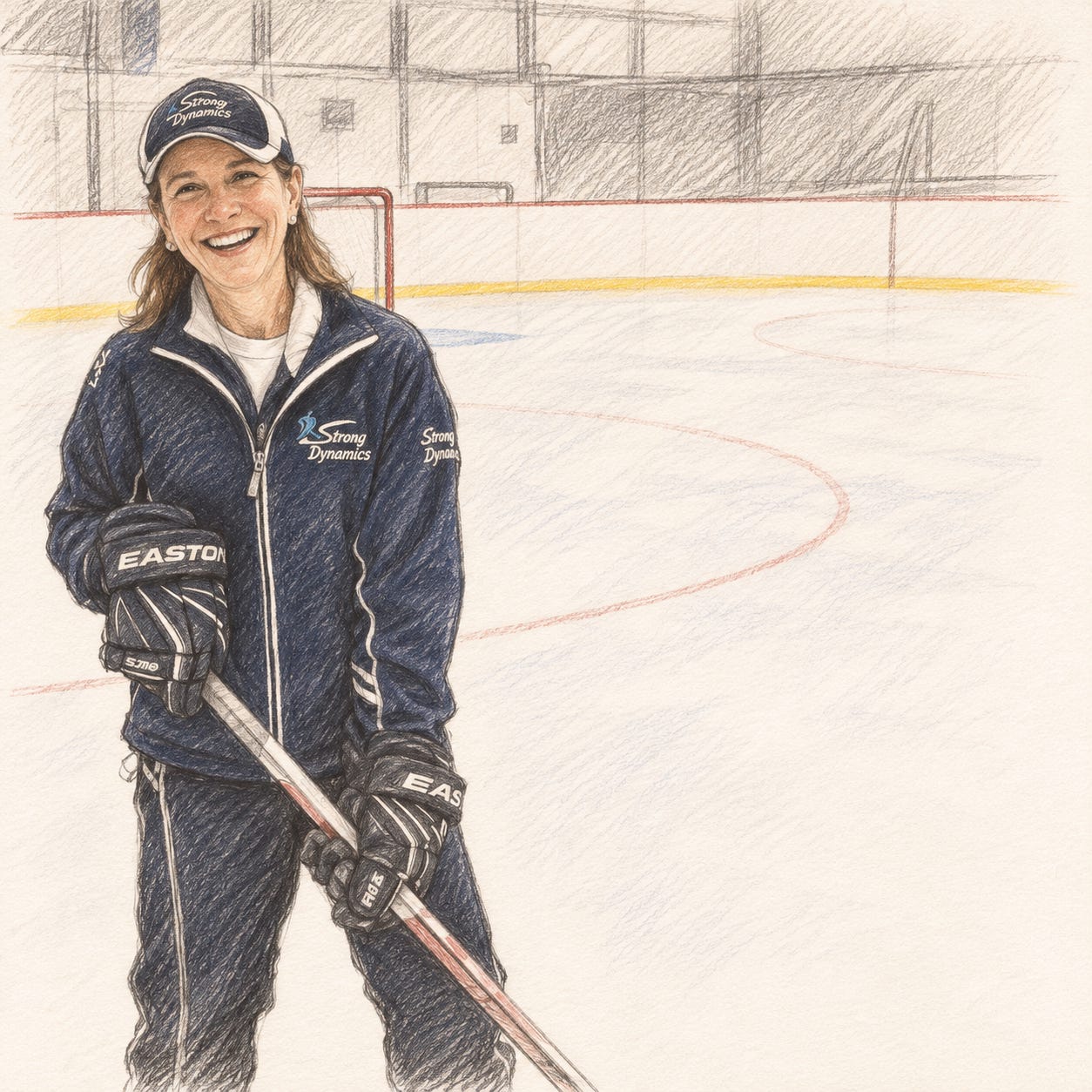
But one of my most important classrooms has been a hockey rink.
Now, at 73, I’m discovering that the lessons I learned there have far more to teach us than how to skate or play hockey.
An Unlikely Beginning
I didn’t grow up playing hockey. I learned to skate and play as an adult.
All five of my children grew up playing hockey, and the sport became an important part of our family life.
Now my grandchildren are continuing that family tradition.
Somewhere along the way, I became more than a hockey mother watching from the stands.
I became a player and a coach.
In the early 2000s, I founded Strong Dynamics Hockey Skating & Agility Training.
I worked with youth hockey players and adults, helping them develop skating skills, agility, and confidence. I organized off-ice summer training programs and pickup hockey games for young people and adults.
Some of my favorite opportunities were the mixed groups, where parents could get on the ice and play hockey with their children.
There is something special about that.
A parent who spends years standing behind the glass watching a child play gets a very different perspective when stepping onto the ice to participate.
Suddenly, parent and child are experiencing the same challenges. They’re making mistakes together, learning from each other, and sharing the joy of the game.
And often the child is the better player.
There’s a wonderful lesson in that reversal of roles.
The person who is accustomed to being the authority isn’t necessarily the person with the greatest skill.
Sometimes the best thing we can do is stop directing and start participating.
Becoming a Coach While Facing Cancer
My development as a hockey coach coincided with one of the most difficult periods of my life.
In 2004, I was diagnosed with breast cancer.
I underwent a bilateral mastectomy and chemotherapy while navigating the responsibilities of raising five children and rebuilding my life after a difficult marriage to an abusive, alcoholic man.
Strong Dynamics had already begun, and I continued developing my coaching work through that difficult period.
I find that connection especially meaningful now.
When you’re dealing with a serious illness, you become acutely aware of how quickly life can change.
Your plans change. Your physical capabilities change. The things you once took for granted become uncertain.
You cannot control everything that happens to you.
And sometimes the challenge in front of you is far greater than anything you’ve trained for.
Hockey didn’t make those experiences disappear. Coaching didn’t give me control over cancer.
But preparation, persistence, adaptability, teamwork, and finding a way forward were principles I was learning to apply both on and off the ice.
I’ve written about those difficult years in my song Just Keep Skating.
What interests me now is how those experiences shaped my understanding of coaching, and how much of what I learned extends beyond sports.
Teaching Skills Is Only Part of Coaching
When I was teaching skating and agility, I worked with people who had different levels of ability, confidence, motivation, and experience.
Some were young athletes with considerable potential. Others were adults learning or improving skills later in life.
A coach cannot approach everyone in exactly the same way.
One person needs to understand the mechanics of an unfamiliar skill. Another needs repetition. Someone else may know what to do but hesitate because they’re afraid of falling or failing.
Giving everyone the same instruction doesn’t necessarily solve their problems.
And pushing harder isn’t always the answer.
Good coaching requires observation.
You have to recognize what’s happening, understand the person in front of you, and determine what will actually help them improve.
My education in biopsychology at Tufts University and nursing at Simmons helped me approach those questions with an understanding of how the body and mind influence one another.
Fear affects behavior. Fatigue affects performance. Previous experiences shape expectations. Motivation varies from person to person.
Sometimes the limitation is physical. Sometimes it’s a lack of knowledge or practice. Sometimes a person has the ability but doesn’t yet trust it.
And sometimes the environment itself is making learning unnecessarily difficult.
The coach needs to be willing to examine that possibility, too.
The Coach Can Become the Biggest Obstacle
One of the most troubling things I’ve observed in sports is how much influence a coach can have on a player’s confidence.
A good coach can help someone discover an ability they didn’t know they possessed.
An ineffective or abusive coach can do the opposite.
When players become preoccupied with avoiding criticism, embarrassment, or punishment, their attention shifts away from the game.
Instead of reading the play, they’re worrying about the coach’s reaction.
Instead of making a decision, they’re trying to anticipate what the coach wants.
And the more afraid they become of making mistakes, the less willing they may be to attempt something difficult.
We see similar behavior in workplaces and families.
Employees stop offering ideas because the boss reacts badly to disagreement.
Children become reluctant to ask questions because they’re afraid of being criticized.
People begin organizing their lives around avoiding someone else’s anger.
That is an unhealthy environment for learning, and it’s an important distinction between leadership and control.
The purpose of coaching is to develop capability, confidence, and judgment in another person.
It isn’t to create dependence on the coach.
I’ve explored that idea in my article, The Coach Doesn’t Play the Game.
At some point, the player must take the ice and make decisions without the coach standing beside them.
The same principle applies to parenting, business leadership, and executive coaching.
If the people you coach can function only when you’re telling them what to do, how much independence have you really helped them develop?
Confidence Is Built Through Experience
We often talk about confidence as though it’s something people either have or don’t have.
But confidence is much more complicated.
Psychologist Albert Bandura developed the concept of self-efficacy, our belief in our ability to perform the actions needed to accomplish something.
One of the most important ways people develop that belief is through mastery experiences: attempting something challenging, practicing, improving, and recognizing their own progress.
I saw that principle at work teaching skating.
You can tell someone a hundred times that they’re capable of learning to skate.
Encouragement helps, but it doesn’t replace experience.
Confidence develops as the person begins finding their balance, controlling their edges, making turns, stopping, recovering from falls, and recognizing their own growing abilities.
And that’s an important distinction.
A coach cannot give another person confidence. A coach can help create the conditions in which confidence grows.
That requires instruction, practice, appropriate challenges, honest feedback, and opportunities to succeed.
It also requires allowing people to make mistakes without treating every mistake as a failure of character.
Sometimes we interfere with that process because we’re too eager to help.
We correct too quickly. We take over. We solve the problem before the other person has an opportunity to figure it out.
And in doing so, we deprive them of the very experience that would help them become more capable.
The Lessons Don’t Stay on the Ice
As my professional work expanded into executive and wellness coaching, I increasingly recognized the same human dynamics I had observed in hockey.
A leader struggling to delegate responsibility may be facing the same underlying challenge as a coach who insists on controlling every decision.
A successful executive confronting an unfamiliar situation may experience the same uncertainty as an adult putting on skates for the first time.
A team that has stopped communicating openly may resemble a hockey team whose members are afraid to make mistakes.
The situations aren’t identical, and the consequences can be very different.
But people carry their fears, expectations, habits, strengths, and relationships into whatever environment they enter.
That is why I find coaching so fascinating.
It requires understanding more than the immediate problem.
Who is this person? What matters to them? What do they believe about their own capabilities? What assumptions are shaping their decisions?
And what is happening in the environment around them?
Sometimes the most valuable thing a coach can do is offer instruction.
Sometimes it’s asking a better question.
Sometimes it’s recognizing an overlooked strength.
And sometimes it’s knowing when to stop talking.
After approximately 40 years in nursing and more than 15 years in executive and wellness coaching, I’ve learned that having knowledge and experience doesn’t mean I have all the answers.
It means I have more questions worth asking.
What Makes a Team Work?
One of the fascinating things about hockey is that having the best individual players doesn’t guarantee having the best team.
A collection of talented individuals can struggle because they don’t communicate, don’t trust one another, or don’t understand their responsibilities.
A less talented group can become remarkably effective because the players work together, recognize one another’s strengths, and contribute to something larger than themselves.
The same is true in business, healthcare, and families.
We tend to notice the stars.
The player who scores the goals. The executive who receives the recognition. The person who delivers the impressive presentation.
But teams depend on far more than their most visible members.
The quiet employee who notices a problem matters.
The teammate who encourages someone after a mistake matters.
The person who consistently does the necessary work without receiving much recognition matters.
And the person sitting on the bench matters.
I’ve written about this in my article, The Bench Is Part of the Game.
One of the responsibilities of leadership is recognizing how different people contribute and helping them understand that their participation has value.
That doesn’t require pretending everyone has equal skills or deserves equal playing time.
It requires treating people with dignity while helping them develop their abilities and contribute meaningfully.
A team doesn’t become stronger by making some of its members feel invisible.
Resilience Isn’t Simply Getting Back Up
Hockey players fall.
Sometimes it’s a spectacular collision. Sometimes they catch an edge. Sometimes they’re simply outplayed.
Getting back up matters.
But there’s more to resilience than getting back on your feet.
You have to understand what happened.
You may need to change your approach, improve a skill, recover physically, ask for help, or recognize that the situation has changed.
I’ve had plenty of opportunities to practice resilience outside hockey.
Cancer, divorce, raising five children, financial challenges, and rebuilding my life have required more than determination.
They’ve required adaptation.
And sometimes they’ve required accepting that the circumstances I was facing were not going to change simply because I worked harder.
That’s an important lesson for coaches and leaders.
When someone is struggling, telling them to try harder may be the least useful advice we can offer.
Perhaps they need better instruction.
Perhaps they need rest.
Perhaps they need an opportunity they haven’t been given.
Perhaps the expectations are unrealistic.
Or perhaps the environment itself is preventing them from succeeding.
Good coaching means being willing to consider all those possibilities.
Resilience is not an obligation to endure harmful circumstances indefinitely.
Sometimes resilience means persisting. Sometimes it means resting. Sometimes it means changing direction.
And sometimes it means recognizing that it’s time to leave the situation altogether.
Knowing When to Change Your Role
Now I’m 73.
I don’t skate nearly as much as I once did.
That’s a reality of getting older, and it has me thinking about how I want to use the knowledge and experience I’ve accumulated.
I still love ice skating and roller blading.
I still love hockey.
I still love coaching.
I still love watching people discover that they can do something they previously thought was beyond their abilities.
But I no longer need to spend hours on the ice to do meaningful coaching work.
In fact, some of the most valuable things I have to offer now have very little to do with skating technique.
They have to do with understanding human behavior, recognizing patterns, building confidence, developing independence, improving communication, and helping people navigate difficult changes.
My experience as a player, mother, grandmother, registered nurse, executive coach, wellness coach, and USA Hockey Level 5 coach has given me many perspectives on those challenges.
And I’m still learning.
One of the challenges of growing older is recognizing when the way we’ve traditionally contributed needs to change.
We can become attached to a role or identity.
Coach. Parent. Executive. Professional. Caregiver. Athlete.
When that role changes, we may wonder what remains.
But perhaps the knowledge and experience we’ve accumulated have prepared us for a different kind of contribution.
I may not be skating as many shifts these days, but I haven’t stopped coaching.
I’m simply taking more of that work off the ice.
The Human Side of Strong Dynamics
Strong Dynamics began as a hockey skating and agility training program.
It gave me opportunities to teach skills, work with young athletes and adults, bring families together through hockey, and develop my understanding of what it means to be an effective coach.
Over time, I recognized that the most interesting lessons weren’t limited to skating mechanics or hockey strategy.
They were lessons about people.
How we learn.
How we respond to pressure.
How we communicate.
How we develop confidence.
How we handle disappointment.
How we exercise authority.
And how we treat people who are struggling.
Those questions are just as important in boardrooms, classrooms, hospitals, workplaces, families, and personal relationships.
They’re the questions I want to continue exploring through Strong Dynamics.
We’ll examine the difference between genuine encouragement and empty praise, accountability and punishment, support and control, independence and abandonment.
We’ll consider why some leaders inspire trust while others demand obedience.
We’ll look at teams that become stronger after setbacks and others that fall apart.
We’ll explore why people resist change, how relationships influence behavior, and what happens when we lose a role that once defined us.
And we’ll continue drawing lessons from hockey, because some of the most complicated aspects of human behavior become remarkably visible when people are working together under pressure.
The Question I Keep Coming Back To
After all these years, I find myself returning to one question.
Why do some people bring out the best in others while others make everyone around them smaller?
Think about the best coach, teacher, supervisor, parent, or mentor you’ve known.
What did that person do that made a difference?
Did they make you feel capable?
Did they challenge you without humiliating you?
Did they recognize something in you that you hadn’t recognized yourself?
Did they help you develop the confidence to make decisions without them?
Now think about someone who had the opposite effect.
Someone whose criticism, anger, control, or need to be right left you questioning your own judgment.
Those experiences can stay with us for years.
And we carry what we’ve learned from them into our relationships with other people.
Which brings me to another question.
What happens to people in our presence?
Do they become more confident, curious, independent, and willing to try?
Or do they become smaller, quieter, and afraid to make a mistake?
Those questions apply to coaches, parents, executives, teachers, healthcare professionals, political leaders, and anyone whose behavior influences another human being.
They also apply to each of us.
I’ve learned that leadership is less about how much authority we possess than about what happens to the people who experience that authority.
And coaching is less about demonstrating what we know than helping other people discover what they’re capable of.
I learned to ask these questions on a hockey rink.
At 73, I’m interested in where they take me next.
And I hope you’ll come along.
Join My Team
Strong Dynamics is a community for people interested in coaching, leadership, human behavior, relationships, resilience, and personal growth.
I draw on decades of experience in hockey, nursing, business, wellness, executive coaching, and family life. I’m continuing to learn, write, and explore the complicated dynamics that shape our lives.
Subscribe for free or become a paid subscriber to help support this independent publication and keep these conversations going.
Your subscriptions, comments, and shares matter. Paid support helps me devote more time to researching, writing, and sharing what I’ve learned.
And I’d especially love to hear from you.
Who was the best coach, teacher, mentor, or leader you ever had? What did that person do that brought out the best in you?
And have you experienced the opposite?
Share your experiences in the comments. We have a great deal to learn from one another.
Join the conversation. There’s always more to learn.